First Day of Spring Activities

I will always be a member of Enchanted Learning (link!!)…I found them about 10 or so years ago, and I have used their ideas constantly!

Floweranatomy_bw
So here are some fabulous ways to incorporate the first day of Spring into your learning!

Egg Carton Tulips
http://members.enchantedlearning.com/crafts/easter/eggshelltulips/Tulips.shtml

Tulip Acrostic Poem
http://members.enchantedlearning.com/poetry/acrostic/tulip/index.shtml


Egg Carton Bugs/Animals
http://members.enchantedlearning.com/crafts/Eggcarton.shtml

Coffee Filter Butterfly Wand
http://members.enchantedlearning.com/crafts/Bfly.shtml

Crayon Stained Glass
http://members.enchantedlearning.com/crafts/Stainedglass.shtml

Flower Anatomy Printout
http://members.enchantedlearning.com/subjects/plants/printouts/labelflower.shtml

Flowering Plant Life Cycle Sequencing Cards
http://members.enchantedlearning.com/subjects/plants/sequencing/floweringplantlifecycle/

Peanut Plant Printout
http://members.enchantedlearning.com/subjects/plants/printouts/peanutplant.shtml

Colorful Flowers Book
http://members.enchantedlearning.com/books/plants/colorfulflowers/

Flower Word Book
http://members.enchantedlearning.com/books/mini/flowers/

Flower Activity Book
http://members.enchantedlearning.com/books/plants/floweractivity/

George Washington Carver Biography and Activities
http://members.enchantedlearning.com/inventors/page/c/carver.shtml

Van Gogh Coloring Pages: Flower Beds
http://members.enchantedlearning.com/artists/vangogh/coloring/flowerbeds.shtml

Tulips Color By Number
http://members.enchantedlearning.com/colorbynumber/tulips/

Sunflowers Color By Number
http://members.enchantedlearning.com/colorbynumber/sunflower/

Fruit in German
http://members.enchantedlearning.com/language/german/label/fruit/

Fruit in French
http://members.enchantedlearning.com/language/french/label/fruit/

Fruit in Italian
http://members.enchantedlearning.com/language/italian/label/fruit/

Homeschooling Product Reviews: Curriculum & Books

We are going on to finish our 6th year of homeschooling, and we have used quite a few homeschool curriculums by now.

 When I first got started, I was pregnant with our 3rd child, had just moved an hour away from where we thought we were going to raise our kids so we had a big fat ZERO community around us, and I had never homeschooled before.  We started with Kindergarten and we are all the way to 5th grade by now!

 
I have definitely paved our own road with this, and it has been absolutely amazing!

How about I give back, and do some reviews?

Continue reading “Homeschooling Product Reviews: Curriculum & Books”

Homeschooling: The Path of Blood, Sweat and Tears

My day as a homeschooling mom is a lot like running on my treadmill.

Lemme ‘splain.

I was not bred for running.  I wasn’t even bred to be athletic.  When I was in Elementary school I was on the worst softball team in the section, The Sprouts.  In High School I was on the swim team, but I wasn’t in a rush so, consequently, I lost most of my swims.  Okay, I lost all of them.

As I got older, with a few pregnancies under my belt and the extra weight that comes with them, I took to running.

This was to help my heart be stronger, get the blood pumping better, my muscles to get a good workout.  I intersperse this with yoga, so I can give the muscles a good stretch.

But still: my body is not a runner’s body.

If you were to look at me, you would agree that I just look maternal.  My face is roundish, my body is roundish.  When I do flex, you will never see the muscles underneath.  I am not a runner, and yet I run.

Last night I was on the treadmill, trying desperately not to look at the timer (4:09min…I can do this…runrunrun…4:15min?! Seriously??)  My mind was pacing back and forth between “I want this. I want to run. I want to be stronger. I want to be in better shape. This is a good thing.”

and

“I could be sitting on the couch reading. I could be working on lesson plans. I could be drinking coffee right now.  I could be relaxing.  Happily.”

Instead of relenting to what would be easier, I pressed on.  By the end of the run, I advanced half a mile farther than the previous run.

But I was still tired, still out of shape, I hadn’t magically lost 15 pounds from one run, and I knew I had to run tomorrow all over again.

I was just thinking of how similar my drive for running was to my drive for homeschooling.  It isn’t going to be finished in a day, and tomorrow we are going to look for the same pencils we are missing today.  We haven’t even begun on Calculus or “Lord of the Flies,” but that’s because we’re still in 3rd grade!  It is going to be a long, arduous road; but it is going to be worth every effort you make, every day you put into it, every year you complete.

——

The path of homeschooling is the path of Blood, Sweat and Tears.

Blood: Quite simply, you are teaching your own blood.  Your students are your own kids, in your home with your hand-picked curriculums.  Your schoolroom is the heartbeat of your children’s education.  Everything you put into the school day, all the effort of choosing what you study emanates from you.  You are putting everything you got into this because you believe in your kids, and you believe in yourself!
At the same time, the days of high blood pressure because no one knows where any of the 50 pencils are, even though you just got them the other day.  Someone has misplaced their math book and have a look in their eyes that questions whether they ever remember even having a math book in the first place…those days are hot blood days, for sure!
Sweat: Have you ever spent a weekend reorganizing the schoolroom, instead of relaxing outside in the sunshine?  “These bookshelves need to go over here, and I’m going to put all of our history books over here, and now I’m going to redesign our lesson plans, and after that I’m rethinking English entirely.”
You put a lot of sweat into your school, no two ways about it.  Every wall has something hanging on it, and every scrap of fabric is kept just in case you need it for future school projects!
You also have those days where you are sweating bullets, wondering if this is going to work.  The truth is, most of us spend a small percent of our week panicking that we aren’t doing enough.  Did the kids get enough out of our study on Greece? Could we have done more?  What is the balance of schoolwork and childhood?  What is the balance of teaching and being a Mom?  Where are the boundaries of when we teach and when we play?  We sweat, and we sweat hard.
That’s the truth of it.
Tears: Oh sure, there are days when you are wrestling with the kids to get work done.  You start rubbing your temples at 10:30 in the morning repeating to yourself, “I can do this, I can do this, I can do this…”  We have all had a few (or more) teary days, especially in the beginning.  It seems like nothing is going right.  We don’t know what we’re doing.   What is going wrong, I had all this planned last week?  Why have we regressed on subtraction all of a sudden?  What is dyslexia?  What books can help with dyslexia?  How did the 2 year old get into the cereal, again??  Where is the 2 year old…..
But the tears when your 4 year old spells “Mom” for the first time are imprinted on your heart, I know it.  When your child who struggles with reading finishes her first page for the first time and looks up at you with the biggest smile, just for you.   After you have completed an entire book of multiplication after drilling the times tables into their heads for months…those tears are worth all the blood and sweat you guys have put into this.   I remember being so overcome with emotion when my kids first learned how to read, when they figured something out, after a huge project was finished.
 
I have cried buckets of tears during my years of homeschooling, and every single one of those tears are worth diamonds.

Celiac in the Suburbs: Going Gluten Free

Sometimes, it feels like going gluten free requires a nutritional certificate and a degree in biochemistry in order to understand what, exactly, you are dealing with.


Trust me, it took me a while to not only get the hang of reading labels and understanding foods, but mostly relearning how to eat…and getting out of denial (“but sandwich bread doesn’t count!”  yes, it does. So does soy sauce, despite my protestations).
I’ve been gluten free for about 8 years officially, and probably a lot longer unofficially.  Because once you reach the point where you actually have a name for all these weird symptoms, you’ll actually have already cut out foods that don’t react well with you.  I cut out macaroni and cheese before I was 20, besides it being one of my favorite foods when I was in college; I had to cut out bread sticks after I passed out after eating a couple while watching a movie with my husband ; and the last bagel I had left me in hives, so that’s gone.  
By the time I actually had the term “Celiac” to explain what was going on, I was already on the path of going gluten free.  I just needed some additional knowledge to help me get there and start recovering.  Unfortunately, this is when it started getting confusing.  I wasn’t raised by nutritionists or chefs, so my ability to pick out food and cook it well was a huge challenge.  Long story short, I was tired of “hidden” gluten labeled under different names, or not named at all, and just started cooking everything from scratch.
But before we get there, let’s start at the beginning. 
 
The first thing a person needs to know when food shopping is that just about everything pre-made has wheat/gluten in it (this is a bit of a gross overgeneralization, since not everything has gluten…but most do, and it’s much safer to say “everything” than “some things”).  Be prepared to become the crazy person reading labels on everything in the store, because that will become your life.  You’ll start finding gluten in things that really shouldn’t have any wheat in it, and you’ll yell at boxes saying, “why are they putting wheat in rice/salad dressing/yogurt?!”  Which is a good question, for the record.
The answer is because it is not only a filler and a thickener, but it adds some nutrients to foods that don’t have much nutritional value.  It’s a big commercial thing, and it’s cheap.  So start reading labels.  Even a little bit of wheat/gluten will affect you.  Like soy sauce: you are going to have to find a gluten free soy sauce.  Salad dressings: you are going to have to avoid caesar salads like it is death (seriously, my worst reaction was on a freaking caesar salad).  So start checking everything, even if you think you’re sure.  Chocolate, ice cream, cereal (even corn flakes), juice, yogurt, bread (obviously), noodles, rice…if it comes in a bag, a box or a bottle, you have to double check.
The second most important thing a person is going to be battling is their habits. People like to eat what is familiar to them, and when you have to change that drastically, it sucks (frankly). Food and eating is part of our lives and part of our culture, and having to re-learn this is annoying on a day-to-day bit, but it also throws us off our personal heritage enough to bug us.  You are going to both give up and re-learn eating, and for a while it’s a pain in the neck. I’m used to it by now, but for the first few months you’re just constantly reminded of what is forbidden, and that gets old fast. Nothing breaded, nothing fried, no doughnuts, no pizza, no regular noodles, no normal hamburgers, no corndogs, no sandwiches. She can give GF bread a shot, and there are a few brands out there that make really good GF stuff; but she’s going to have to replace these substitutes for what she’s used to. That just takes patience, and I have found it takes about 2 or 3 weeks to really get the hang of it, and a few months to own it.
Once you get to this point, you will find something that might be alarming…and it isn’t:  you will find yourself getting hungry more often, which isn’t a side effect of anything.  You are removing the foods that fill and expand, and hunger is going to be surprising.  It is important to make sure you think of your meals as a balance of foods that nourish and foods that fill.  So, rice and potatoes are very helpful in that area.  Snacks are also very helpful, and I usually recommend high protein snacks like nuts or apples to fill you up and give you some pep during the day. 
And, although you probably already know this, but filling a hungry stomach which is already being deprived of food that it is used to with sugar/junk is just going to make you feel worse.  And cranky.  Avoid this, because it is just a slippery slope.  Fresh food is the best option to good health.
I have been doing 100% gluten free for about 9 years now, and my methods are different than other people’s methods at this point.  My road has been through the forests of gluten free bread, the plastic rice cracker aisle and staring longingly at pizzas, remembering the good old days.  
By now, I make just about everything from scratch, because I got absolutely sick of surprises.  Nothing ruins a night by laying in bed with shallow breathing, heart palpitations, muscle contractions, flushed cheeks and kicking yourself for not seeing the millionth ingredient on the label.
The book I use to make anything gluten free is “The Gluten-Free Gourmet Cooks Comfort Foods” by Bette Hagman.  She has a few other books that I’m going to be getting, but this is THE BEST resource.  You use her recipes for mixes to make everything in the book; so I have 5 big jars in my cupboard with her “potato bread” mix, “sourdough bread” mix, “featherlight” mix.  From these I can make cakes, scones, muffins, bread, rolls, hamburger buns, pot pie dough, etc.  But the biggest thing for me is that even though it costs a little bit to buy all the different flours and starches to make the mixes, they will last you all year.  This is much more economical than buying a $7 bag of french bread mix.  I can’t recommend this highly enough.
As for noodles: rice noodles are horrible.  They are gray and they get soggy and fall apart.  Unless you are covering them with something that will make them taste okay, they’re not really worth it.  You have to try them first, of course, to see this.  However: corn noodles and quinoa noodles are the best.  Corn noodles are great for spaghetti, hands down.  Quinoa noodles are great for anything else, including cold pasta salad.  Both of these hold their shape and taste good.  Feel free to try out stuff on the gluten free aisle, including Amy’s pizza (even though a small one is freaking $12).  It’s okay, but I still haven’t made a pizza that tastes like a pizza.  I’ve made my own crust, and if you add a TON of oil under and on top, it gets a pretty good pizza crust.  
For recipes: my best advice is to start with meals you already cook and just remove the wheat portion.  


Replace bread with corn tortillas or lettuce wraps.  You can use store bought bread, but that will be a one-time thing.  No one can stomach the cement that is store bought GF bread.  Oats are a gray area, because biologically oats don’t grow gluten.  However: they are so thoroughly contaminated from both the field and the processing, that I avoid it completely.  Bob’s Red Mill has gluten free oats that are good though, and you can make oatmeal or whatever from those.  

I think that’s about all I can think of!  Mostly when you’re first starting out I would say, give yourself time to adjust.  It might seem daunting on some days, but once you get used to a new rhythm, you’ll see that it’s really not that complicated.
Good luck 🙂
Chickpea Burgers

img_4972

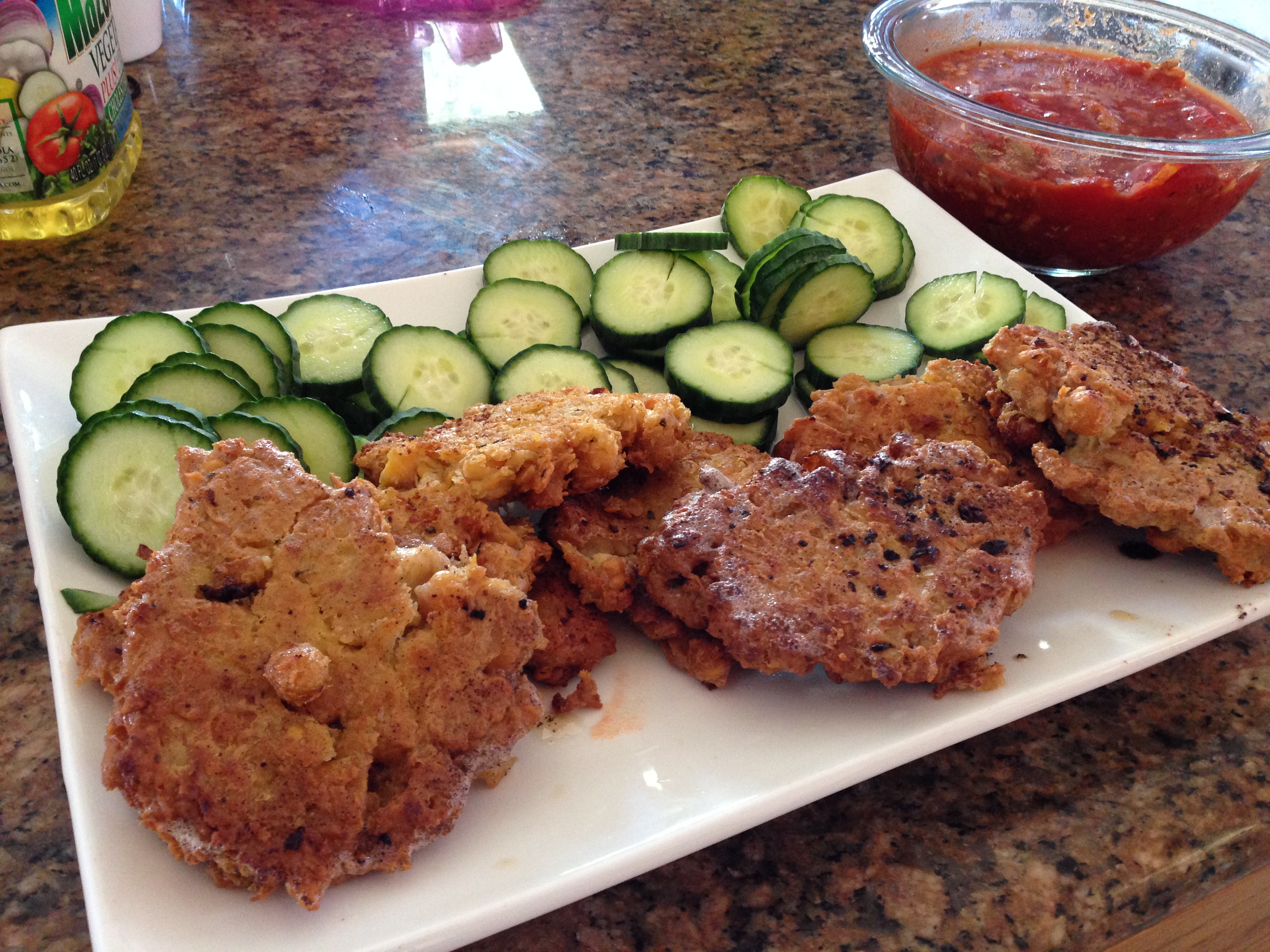
These things are so fantastic, I am making them constantly these days.

The creamy, buttery chickpea taste met with the crispy outside.  These are good for lunches, dinners, appetizers or picnics!

IMG_4972

Here is the recipe!

Ingredients:

  • 4 cans of chickpeas, or about 4 cups of cooked chickpeas
  • 2 eggs
  • 1 handful of chopped, fresh parsley
  • 1 Tbsp garlic powder
  • 1 tsp kosher salt
  • ground black pepper
  • 1 can of stewed tomatoes
  • 1/4 c. corn oil

IMG_4969

Directions:

  1. Take the cooked chickpeas and put them in a large pan with 2 Tbsp of oil.  Add the salt, garlic powder, pepper and cover for 10 minutes.
  2. Remove the chickpeas and put them into a mixing bowl.  Mash lightly, but with gusto.
  3. Add the eggs and stir until well combined
  4. Add 1/4 c corn oil into the pan and heat until simmering
  5. Drop 1 large spoonful of chickpeas into the pan to create a patty,and lightly smoosh it down with the spoon. You should be able to fit 3 patties into the pan.
  6. Cover and fry for 4 minutes each side
  7. Remove and put onto a plate to cool
  8. Serve with hot stewed tomatoes for the full experience!

IMG_4972

Gluten Free Clam Chowder

Tamarah.org Recipe!

Clam chowder is one of the best soups out there, for some reason.  I sincerely miss the chowder bowls on the SF pier…but those things would probably put me into some Celiac coma right now.  But it doesn’t mean I can’t make some lovely gf chowder!

  • 3 cans clams, minced (preferably..or just chop them yourself.  Tastes the same in the end.)
  • 1/2 lb bacon (keep a little on the side for garnish)
  • 1 cup chopped yellow onion
  • 1 big rib of celery, sliced
  • 1 carrot, peeled and finely chopped
  • 3 cups of diced, uncooked red potatoes
  • 1 tsp kosher salt
  • Fat grind of ground pepper (my dad would probably be okay with 3 or 4 fat grinds…that’s okay too)
  • 2 cups half-and-half
  • 2 cups milk
  • (optional: dairy free option) 6 ounces full-fat coconut milk plus 6 ounces almond milk
  • 2 tablespoons butter
  • 1 pinch paprika
  • 1 fat pinch thyme

Get Out Your Pressure Cooker!

  1. First, drain the clam juice into a bowl, then add enough water so there is 4 cups of liquid in the bowl.
  2. In your pressure cooker, brown the diced bacon.  When it’s about done, remove the bacon and drain most of the drippings.
  3. Now saute your onion for about 2 minutes, then add the potatoes, salt, pepper and the bowl of clam liquid.
  4. Add potatoes, carrots, celery, thyme, paprika, salt, pepper and reserved clam liquid
  5. Cook on high for 7 minutes
  6. Add half and half, your milk of choice, butter, bacon and clams.  Cook for 1 minute.  Garnish with bacon.

Side Note: If you want it a little thicker, stir in 1 Tbsp cornstarch mixed with 1/4 cup warm water while you’re cooking the potatoes
Or Use Your Stove:

  1. First, drain the clam juice into a bowl, then add enough water so there is 4 cups of liquid in the bowl.
  2. Then cook the diced bacon in a big pot.  When it’s about done, remove the bacon and drain most of the drippings.
  3. Now saute your onion for about 2 minutes in the pot, then add the potatoes, salt, thyme, paprika, pepper and the bowl of clam liquid.
  4. Add potatoes, carrots, celery, salt, pepper and reserved clam liquid
  5. Cook on high for 40 minutes
  6. Add half and half, your milk of choice,, butter, bacon and clams.  Cook on low-medium for 5 more minutes.   Garnish with bacon.

My Most Famous Baked Chicken Recipe Formula

Sit down folks, I’m going to tell you a tale:

This is the story of a young lady who believed, believed deep down in her heart, that chicken recipes could be redeemed.

She believed chicken breasts did not have to be dry.  She believed a whole chicken could have endless flavor, and not just a sticky salt and pepper skin that you chew through.

Chicken was a blank canvas, and the cook only had to wield the brush.

Now, here is my theory of cooking chicken, and this is important:

There are 3 layers to cooking chicken – 

1) The base

2) The wet

3) The seasonings

  • Bake at 350F for an hour, uncovered
  • Pressure cook on high for 25 minutes


It might seem too simple, but this is the chemistry of chicken, and you can mix it up however you want.  Just as long as you have this formula, you will always, ALWAYS, have amazing chicken.

For example:

  • 1 whole chicken
  • 1 can of stewed tomatoes, olive oil
  • garlic powder, parsley, kosher salt, ground pepper

or

  • 1 whole chicken
  • 1 can corn, olive oil
  • garlic powder, paprika, cilantro, kosher salt, ground pepper

or

  • chicken pieces
  • 1 can of chickpeas, 1 can of stewed tomatoes, olive oil
  • garlic powder, parsley, kosher salt, ground pepper

or

  • chicken breasts
  • 1 can of sliced pears
  • brown sugar, cinnamon, kosher salt

or

  • 1 whole chicken
  • 1 cup of rice with 1 can organic stewed tomatoes
  • kosher salt, garlic powder, oregano

The combinations are endless, but the formula is the key!!

Holiday Turkey

This is a depression era recipe that was passed down to me, and it has never failed me.

It is astounding how complicated turkey can become…is it too dry, is it burnt, do you deep fry the turkey, do you set your house on fire by deep frying the turkey…  There are so many avenues to go down.  But Thanksgiving is supposed to be relaxing; how about we keep this simple and delicious.

img_3962

What you need:

  • A huge baking dish (I use the aluminum ones from the store)
  • A huge turkey
  • Crisco
  • 2 large paper bags
  • 1 apple
  • 1 butternut squash or yams
  • 1 yellow onion
  • Olive oil
  • Kosher salt, ground black pepper, garlic powder, thyme, fresh rosemary
  • yellow dish gloves
  • paper towels

Assembly:

  1. Preheat your oven to 425F   I will also suggest you make sure your oven is clean before you set it this high.  You might have small fires on the bottom of your oven if it has crumbs or anything.  Just speaking as a friend, here.
  2. Wash your turkey in the sink, just to get debris/blood off.  Also empty the cavity of the neck/organs.
  3. Now, take a paper bag, paper towels, the Crisco and set them aside together.  With your gloved hands, take a paper towel and get a big scoop of Crisco on it.  Now, start lining the inside of the paper bag with the Crisco.  It doesn’t have to be a thick layer at all, just make sure you get every inch of the inside coated with Crisco.  Do this to both bags.          –-this is going to keep the moisture of the turkey stable while it is cooking, as well as preventing the bags to catch on fire.
  4. Go back to the turkey and place it in the baking pan.  Pour olive oil on top to coat the skin, then sprinkle all the spices on top.        – The olive oil is going to make the skin moist and crispy, and the spices stick to it if you do it in this order
  5. Cut the apple, yellow onion and peeled yams and put them in the turkey      –-you could easily use butternut squash, but I have crazy reaction to them, so I stick to yams.  Also, this step is to season and moisten the turkey from the inside, plus it makes a fantastic gravy afterward.
  6. Slide one of the bags around the turkey, and then slide the other bag on the other side of the turkey.  I used to be able to fit a turkey in one bag, but they made the bags smaller over the years, so now you have to use 2.
  7. Your turkey should be completely enclosed in this bag tent, and resting in the baking pan.
  8. Place the pan in the oven at 425F for 20 minutes.  It will smoke a little bit at first (just the Crisco cooking, no worries), so open a window.
  9. Turn the heat down to 325F for the rest of the time.  How long?  15 minutes per pound.

This will absolutely be the best turkey you have ever made.  It is always moist, has tons of flavor, the gravy is fantastic.  Love, love, love.

Gluten Free Butternut Squash Macaroni & Cheese

Gluten Free Butternut Squash Macaroni & Cheese


I think that technically, this is an incredibly healthy dish.

You have the quinoa pasta, which has a bunch of protein, and you have a whole butternut squash in here, which is awesome.  I’m just going to call it: this is healthy.  BOOYA!
Ingredients:

  • 1 sliced, baked butternut squash
  • 1 box quinoa elbow macaroni
  • 4 Tbsp butter
  • 1/3 cup flour
  • 1 1/2 cups milk
  • 1 tsp dry mustard
  • 2 tsp salt
  • 1/4 tsp ground nutmeg plus more for sprinkling
  • heaping 1/4 teaspoon of paprika
  •  4 cups sharp cheddar cheese, shredded
  • 1 cup chicken  stock
  • 1  1/2 cups of gluten free bread crumbs

Hold On To Your Hats, Folks!:

  1. Get your oven to 350 degrees F, pronto, Jack.
  2. Take your butternut squash and use a vegetable peeler to peel the skin off.  Slice it in half, scoop the seeds out (you can plant these in your garden, fyi) and place them in your pressure cooker.  Add 2 cups of water and cook on high for 4 minutes.
  3. When squash has cooled, set aside 1 cup of it, and use a stick blender to get the rest to a good, smooth consistency…with out turning it into a smoothie.
  4. While all this is going, cook the macaroni in boiling water for 8 minutes.  Drain and set aside.
  5. Now, Melt 3 Tablespoons butter in a pot and slowly stir in the 1/3 cup of flour to form a paste.
  6. Take it off the heat, and gradually whisk in 1 1/2 cups of milk. Return to medium low heat until the sauce  is fully blended and thickens.
  7. Then, add pureed squash to the thickened sauce.
  8. Add all your mustard, salt, nutmeg, and paprika. Stir in 3 1/2 cups of cheese (set aside 1/2 cup for the topping) and 1 cup of stock, alternating cheese and stock by cupfuls. Make sure you taste it during this stage to see if you need more nutmeg, mustard or paprika for your taste!  This is your dish…own it!
  9. Okay, finally combine pasta, squash chunks, and cheese sauce in a large baking dish, toss to coat evenly.
  10. Melt the remaining Tablespoon of butter and blend it with the rest of the  1/2 cup of cheese and the breadcrumbs to make the topping. Spread this over the macaroni.
  11. Now, place that casserole dish into your oven and bake it for 20 minutes at 350F.
  12. Take that steaming dish out and let it cool, because baby, it’s hot in here…and it’s not just you this time 😉


This is an AWESOME dish that will be a big hit every time!

Enjoy!!

Gluten Free Chicken Pot Pie

Yes.

It can be done.


What you need:

The Crust:

  • 3/4 cup Bisquick® Gluten Free mix
  • 1/2 cup milk
  • 1 egg
  • 2 tablespoons melted butter

Do It!

Throw all these ingredients in a bowl and mix it together with a fork.  You’ll be spooning it on top of the chicken/veg mixture in the end.

The Filling:

  • Chicken (I’ll let you decide how to get this.  I tend to bake/boil a chicken and use the meat off that, but you can use bonelesss skinless chicken breasts, or whatever is easier for you)
  • Ground sage, parsley, garlic powder, kosher salt, coarse ground pepper
  • 1 cup Sour cream
  • 1 cup chicken stock (it’s handy if you boil a chicken, you have fresh stock right there!  BooYa!!)
  • 2 carrots, diced
  • 4 red potatoes, diced
  • 1 yellow onion, diced
  • 1 small can of peas and carrots.  (This one goes against every fiber in my body, since I’m generally opposed to peas….but canned peas make the dish.  Unfortunately.)

Make It!

Okay, now I do it a little different, so here it goes.

Throw all the raw chicken and veg in a huge pan and cook it there.  You get a better flavor and better consistency in a pan for this dish.  In the oven it tends to get a little mushy, for me.

Once this is cooked (about 20 minutes, I’d say), put the chicken and veg into a deep casserole dish.  I will admit, I don’t even have a deep casserole dish.  I have two white casserole dishes, and they kinda work for us.  But if I had a deep casserole dish, that’s what I would use!

Take the 1 cup of chicken stock and pour it into the pan with 2 Tbsp of cornstarch.  Heat it up until it’s thick and smooth, and then turn the stove off.  Stir in the sour cream gently, and then pour this over the chicken filling.  This will make the gravy, and it will combine with the potatoes and dough to be super great.

Now spoon the crust on top of the filling, and then spray the top with Pam.  It’ll be nice and brown and crispy when it’s done.

So throw this sucker into the oven, which you have preheated to 400F (right?) and let it be groovy in there for about 20 minutes.

En.Joy.  This is a great Fall/Winter meal 🙂